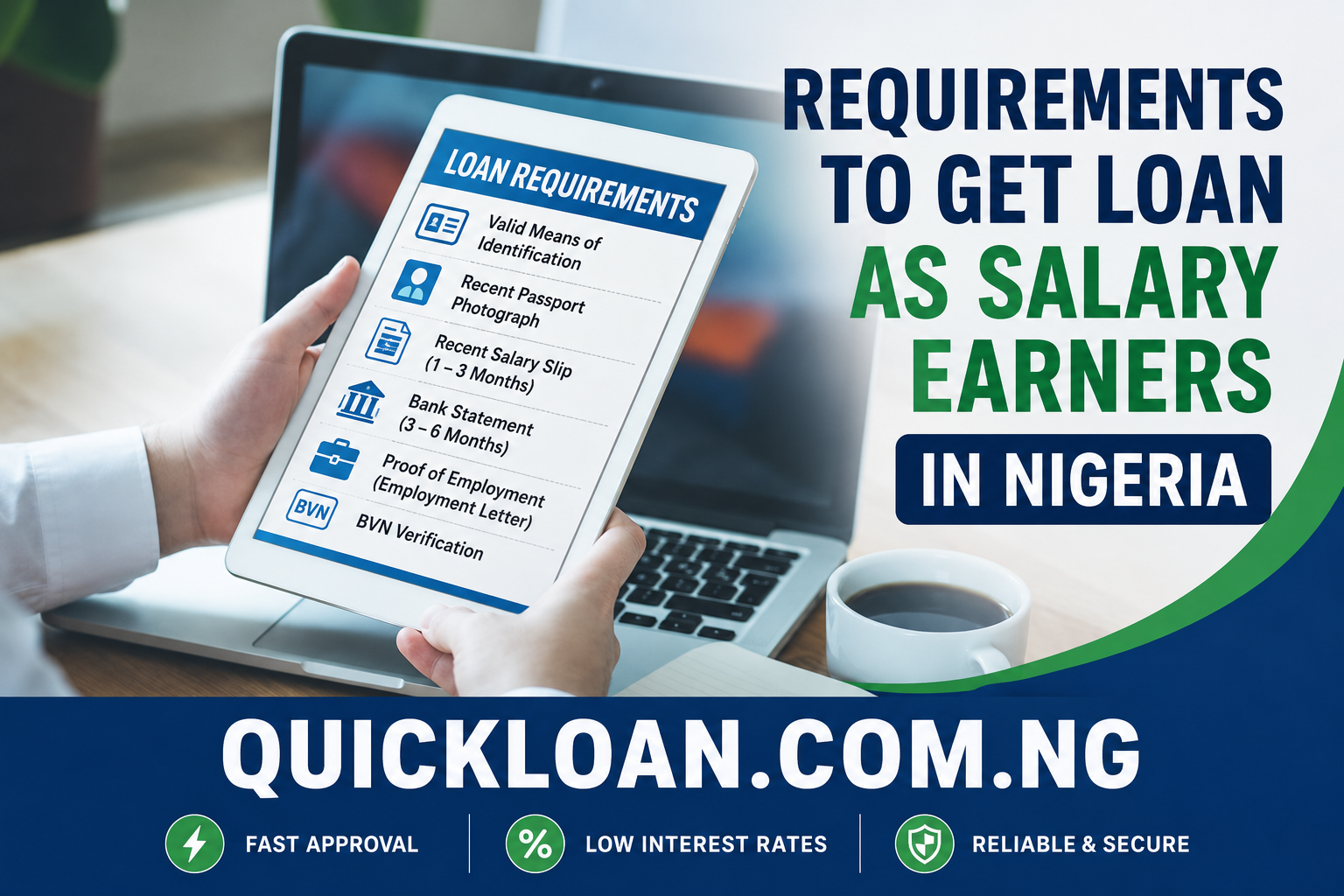
Requirements for loan for salary earners in Nigeria; Are you considering taking a loan in Nigeria as a salary earner, this may be geared towards emergency, starting a side hustle, or pay a rent, etc., as the case may be. If this feels like you, I’ve got you covered.
Here’s the best truth; many people don’t realize getting a loan is not just about applying exact criteria lenders look for.
In this guide, I’ll walk you through the requirements for loan for salary earners in Nigeria, based on real-world lending practices used by banks, fintech apps, and microfinance institutions.
How loan works for salary earners
Let’s quickly break this down before diving into the requirements. As a salary earner, lenders perceive you as a lower risk compared to business owners.
And why?
Because you have a steady monthly income going for you. However, that doesn’t mean your loans are automatic by any adjustment, lenders still want proof that;
- You earn consistently
- You can easily repay without defaulting
- Your financial behavior is trustworthy
That’s where the requirements come in.
Requirements for Loan for Salary Earners
1. Proof of employment
This is the first thing every lender checks, you must demonstrate that you are actively employed, either in;
- A government job
- A private company
- A reputable organization
Documents you need to provide include but are not limited to;
- Employment letter
- Staff ID card
- Confirmation letter for permanent staff
Example
If you work in a bank or telecom company, your chances of getting approved are usually higher because lenders trust established employers.
And why?
Their salary will always come timely.
2. 3-6 months salary account statement
A most common important parts of the requirements for loan for salary earners in Nigeria is the salary account.
Lenders will ask for your
- Bank statement
- Salary inflow records
Why so?
They are checking;
- How much you earn monthly, this should determine your loan limit
- How consistent your salary drops
- Your spending habits
Example
If you earn N150,000 monthly but spend everything before next payday, lenders are likely to reduce your loan amount, better still reject your application.
3. Valid means of identification
It’s on you to prove your identity, some of the accepted IDs include but are not limited to;
- National ID
- Voter’s card
- Passport
- Driver’s license
This helps lenders verify that you are a real person and prevents fraud.
4. Bank Verification Number (BVN)
When you think of taking out a loan, your BVN is one of the most compulsory details required. Lenders use BVN to;
- Check your credit history
- See if you are indebted to other lenders
- Confirm your identity across banks
If you’ve defrauded on previous loans, it will reflect here and affect your chances negatively.
5. Good credit history
This is where most fresh applicants fail. Lenders check your record with credit bureau to see;
- If you’ve taken loan before
- If your repaid on time
- If you defaulted
Example;
If you borrowed N50,000 from a loan app and didn’t repay, even banks will reject your future loan applications.
6. Minimum salary requirements
Most lenders have a minimum income threshold such as;
- N30,000 – N50,000 for fintech apps
- N80,000 – N100,000+ for banks
The higher your salary, the higher your loan eligibility.
7. Age requirement
You are required to be at least 21 years old, not older than 55-60 years depending on the lender.
This goes to demonstrate you are within the working bracket and can service the loan.
8. Proof of residence
You are usually required to show;
- Rent receipt
- Address verification
This helps lenders to know where you live in case follow-up is needed.
9. Employer verification
Some lenders go further to confirm;
- Your employment status
- Your salary level
- Your job stability
This is common with commercial banks high value loan application.
10. Debt-to-income ratio check
Lenders calculate how much of your salary is already committed to expenses or debts. If your debts are too high, your loan may be denied.
Your total loan repayment should not exceed 30-40% of your monthly salary.
Additional requirements
Not all lenders are the same, some may ask for extra details like;
- Guarantor, especially for cooperative and Microfinance bank loans
- Collateral, for larger loans, you may need land documents, vehicle papers, and fixed deposits
- Salary domiciliation, this means your salary must be paid into the lender’s bank.
Example;
If you want a loan from a bank, they may require your salary account to be with them.
Types of loans available for salary owners in Nigeria
Understanding loan types helps you know what requirements to expect.
Personal loan: No collateral required, loans are based on salary and credit score
Payday loans: Short-term loans usually repaid on next salary date.
Salary advance: Loans offered by fintech apps with quick approval
Asset financing loans: Loans used to buy cars, gadgets, etc., asset may serve as collateral.
Mistakes salary earners make when applying for loans
Even if you meet the requirements for loan for salary earners in Nigeria, these mistakes can ruin your chances.
- Applying to too may lenders at the same time
- Providing fake documents
- Ignoring existing debts
- Poor account management
How to increase your chances of loan approval
As a professional loan officer, here’s what I recommend;
- Maintain a clean bank statement, avoid unnecessary withdrawals immediately after salary
- Build a good credit history, start small and repay on time
- Use one primary account, consistency helps lenders track your income easily
- Avoid loan default at all costs, even one default can follow you for years.
Example
Let’s make this practical.
Emeka earns N120,000 monthly. He has a stable job in a telecom company, his salary comes in regularly with no outstanding loans.
Emeka can easily qualify for a loan of N200,000 – N500,000 depending on the lender.
What are the basic requirements for loan for salary earners in Nigeria?
You need;
- Proof employment/employment letter
- Salary account statement
- Valid ID
- BVN
- Good credit history
Can I get a loan without a payslip in Nigeria?
Yes, some fintech apps don’t require payslips, but they will still check;
- Your bank transactions
- BVN
- Your income pattern
Which loan apps give loans to salary earners easily?
Many apps provide quick loans, but approval depends on;
- Your credit score
- Transaction history
- Repayment behavior
How much loan can I get as a salary earner?
It depends on;
- Your monthly salary
- Your credit history
- Your existing debts
- Leners offer 1-5 times your monthly salary.
Can I get a loan if I have bad credit history?
It’s difficult but not impossible. You may get smaller loan amounts, pay higher interest rates.
Do banks give loans to salary earners in Nigeria?
Yes, banks offer loans, but their requirements are stricter compared to loan apps.
Is BVN compulsory for loans in Nigeria?
Yes. Almost all lenders require BVN for identity and credit checks.
Conclusion
Getting a loan as a salary earner in Nigeria is not as difficult as many people may think if you understand what lenders are looking for.
The takeaway is simple;
Meeting the requirements for a loan for salary earners in Nigeria is not just about documents, it’s about your financial behavior.
If you manage your salary well, maintain a clean credit record, and avoid unnecessary debts, you’ll not only get approved, you’ll get better loan offers with lower interest rates.